Quick answer
In Ontario, the G1 knowledge test is your first step to driving. It is a multiple-choice test on road signs and the rules of the road, based on the driver's handbook. It isn't timed, and you need 80%. DriveTest says a retry within one year covers only the parts you failed. The number of questions isn't published, so the app's practice test uses 20 per part, marked to be confirmed.
The G1 knowledge test at a glance
| Licence | G1, Level One of Ontario's graduated licensing |
|---|---|
| Test | Multiple choice, in two parts: road signs, and rules of the road |
| Questions | Not published to be confirmed |
| Pass mark | 80% |
| Time limit | None: the test is not timed |
| If you don't pass | A retry within one year covers only the parts you failed |
| Where | At a DriveTest centre |
How the app practises the Ontario test
Ontario · practice test in the app
G1 knowledge test
- Road signs20 questions · 16 to pass (80%) to be confirmed
- Rules of the road20 questions · 16 to pass (80%) to be confirmed
The app's Ontario practice test has the same 2 parts, answered one after another. Each part is scored on its own against its pass mark, and you see a result for each part as well as your total. Because the official number of questions isn't confirmed, the app uses 20 per part, scored at the published pass mark, and says the count is to be confirmed. If you miss a part, you can practise just that part again. Every result is a practice result only, never an official one.
Try one: an Ontario practice question
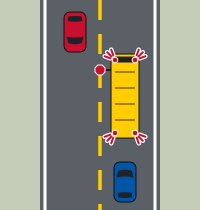
Your car (the blue car) is behind this stopped school bus. Its upper red lights are flashing. Where must you stop?
Show the answer and the explanation
The answer is D: at least 20 m behind the bus.
In Ontario, when a school bus has its upper red lights flashing, traffic coming from behind must stop at least 20 m away.
- Why not AOntario requires a larger gap than 5 m.
- Why not BChildren may walk around the bus; give them room.
- Why not CYou must stop whenever the red lights are flashing.
Source: MTO Driver's Handbook, Stopping for school buses
What the Ontario question bank covers
The Ontario bank has 300 practice questions (Road signs: 100; Rules of the road: 200), written for Ontario only from the Official MTO Driver's Handbook on ontario.ca. Every question is in English and French, and every answer explains why it is right, why each wrong choice is wrong, and where the rule comes from in the handbook.
Topics covered (30)
- Regulatory signs
- Warning signs
- Construction and temporary signs
- Information and guide signs
- School, playground and pedestrian signs
- Traffic and pedestrian signals
- Pavement markings
- Your G1 licence and graduated licensing
- Right-of-way
- Intersections and turns
- Roundabouts
- Speed limits and speed control
- Space and following distance
- Lanes, lane changes and passing
- Highway and expressway driving
- Parking and stopping
- Pedestrians and cyclists
- School buses
- Emergency and roadside vehicles
- Sharing the road (trucks, motorcycles, farm vehicles, transit)
- Railway crossings
- Alcohol, drugs and impaired driving
- Distracted and fatigued driving
- Seatbelts and child car seats
- Night driving, weather and winter
- Skids, emergencies and breakdowns
- Collisions and reporting
- Licence, registration and insurance documents
- Wildlife, rural and gravel roads
- Defensive driving and hazard awareness
How to study for it
Read the handbook first
The test is based on the Official MTO Driver's Handbook on ontario.ca. Read the chapters on signs, rules of the road and your licence before you drill questions.
Learn signs by shape and colour
Shape and colour tell you the type of sign before you can read it: an eight-sided red sign means stop, a diamond is a warning. Then learn each exact meaning.
Practise each part on its own
Each part has its own pass mark, so a good total isn't enough. Make sure you are solid on every part.
Fix your mistakes, not just your score
For each question you miss, read why your choice was wrong. The app brings it back in your plan so it sticks.
Book when you pass consistently
Take full practice tests and book the real one when you pass them again and again, not once.
Questions about the Ontario test
How many questions are on the G1 test?
DriveTest doesn't publish the number. The app's practice test uses 20 road-signs questions and 20 rules questions, scored at 80% in each part, and marks the count as to be confirmed.
What happens if I fail one part?
DriveTest says a retry within one year covers only the parts you failed. In the app, you can practise just the part you missed.
Is the G1 test timed?
No. Take your time and read every choice.
Are the app's questions the ones on the Ontario test?
No. They are original practice questions, written for Ontario from the Official MTO Driver's Handbook on ontario.ca. They teach the rules the test checks, but they are not the test, and the app is not connected to any government.
Can I practise in French?
Yes. Every question, explanation and source note is in English and French, and you can switch language at any time.
Practise for Ontario with Learners Test Canada
Learners Test Canada is an independent study app. It is not affiliated with, endorsed by or connected to the Government of Canada or any provincial or territorial government or licensing authority.
Android app. It is not on Google Play yet; the link will appear here when it is.